
Syntactic analysis is an important process in language comprehension and effective communication. In this article, you will learn how to perform syntactic analysis step by step to identify the parts of a sentence and understand how they relate to one another. If you wish, you can do some syntactic analysis exercises after you finish reading.
What is parsing?
Before we begin, it is important to understand what parsing is. It is the process of analyzing a sentence to identify the different parts that make it up, such as the subject, the verb, the direct and indirect object, among others. Syntactic analysis helps you understand how the different parts of a sentence are related to convey a clear message.
How is a syntactic analysis done?
To do a syntactic analysis, we must first identify the different parts of the sentence. Next, we can label each part according to its grammatical function. Here are some steps to follow to do some basic parsing:
Step 1: Identify the subject
The subject is the part of the sentence that performs the action. To identify the subject, it is necessary to ask who or what performs the action? For example, in the sentence "John eats an apple," the subject is "John."
Step 2: Identify the verb
The verb is the action that the subject performs. To identify the verb, it is necessary to ask what the subject does? For example, in the sentence "John eats an apple," the verb is "eat."
Step 3: Identify the direct complement
The direct object is the part of the sentence that receives the action of the verb. To identify the direct object, it is necessary to ask who or what receives the action of the verb? For example, in the sentence "John eats an apple", the direct object is "an apple."
Step 4: Identify the indirect object
The indirect object is the part of the sentence that indicates to whom or for whom the action of the verb is performed. To identify the indirect object, it is necessary to ask: to whom or for whom is the action of the verb performed? For example, in the sentence "John gives an apple to Mary," the indirect object is "to Mary."
Step 5: Identify the circumstantial complement
The circumstantial complement is the part of the sentence that indicates the circumstances in which the action is performed. To identify the circumstantial complement, it is necessary to ask where, when, how or why the action of the verb is carried out? For example, in the sentence "John eats an apple in the park", the circumstantial complement is "in the park."
Step 6: Identify the predicate
The predicate is the part of the sentence that includes the verb and the complements. To identify the predicate, it is necessary to look for the verb and the complements that accompany it. For example, in the sentence "John eats an apple in the park," the predicate is "he eats an apple in the park."
Step 7: Identify the agent plugin
The agent complement is the part of the sentence that indicates who performs the action when the subject does not. It is used in passive sentences.
Step 8: Identify the omitted subject
In some sentences, the subject may be omitted, but it is still important to identify it. To do this, it is necessary to look up the verb form of the verb and determine who it refers to. For example, in the sentence "You live well in this city", the subject is omitted, but it can be inferred that it refers to "the people" or "the people."
Step 9: Identify subordinate clauses
Subordinate propositions are those that depend on another main proposition to make sense. To identify them, it is necessary to look for the words that introduce the proposition, such as "that", "who" or "when". For example, in the sentence "John, who is my friend, eats an apple," the subordinate clause is "who is my friend."
Step 10: Identify compound sentences
Compound sentences are those that have more than one proposition. To identify them, it is necessary to look for the words that join the propositions, such as "and", "or" or "but". For example, in the sentence "John eats an apple and Mary eats a pear," there are two propositions joined by "and."
Step 11: Identify syntactic functions
Each word in a sentence has a specific syntactic function. To identify them, it is necessary to know the different functions, such as subject, verb, direct object, indirect object, circumstantial object, among others.
Step 12: Identify the different types of sentences
There are different types of sentences, such as affirmative, negative, interrogative, among others. To identify them, it is necessary to pay attention to the words that introduce them, such as "no" for negative ones, or interrogative words, such as "what" or "who."
Step 13: Practice with different examples
To improve syntactic analysis, it is important to practice with different examples. It is advisable to use written texts or talk with other people to identify the different parts of speech and their syntactic function.
Step 14: Review and correct
Once the syntactic analysis has been done, it is important to review and correct possible errors. It is advisable to read the sentence several times and verify that all parts are correctly identified.
Step 15: Use parsing in communication
Finally, syntactic analysis is an important tool for effective communication in Spanish. By understanding the different parts of a sentence and their syntactic function, it is possible to communicate more clearly and accurately.
https://youtu.be/MEkBVLNjdLs?si=zLNbsNeY4k355Ahl
FAQ
Why is it important to do syntactic analysis?
Doing syntactic analysis is important because it helps us understand the grammar of a language. By understanding the structure of a sentence, we can identify grammatical errors and improve our writing. Furthermore, syntactic analysis is an important tool for translation and interpretation.
How can I improve my parsing skills?
There are several ways to improve your ability to do syntactic analysis in Spanish. One way is to read and analyze texts in Spanish, paying attention to the structure of the sentences and the different elements that make them up. You can also practice doing parsing exercises and asking a teacher or tutor for feedback.
What are common errors in parsing?
When doing syntactic analysis, it is common to make mistakes, especially if you are new to the subject. Some of the most common errors include:
- Confuse the subject with the direct or indirect object.
- Not correctly identifying verbal and nominal complements.
- Not recognizing adjectives and adverbs in the sentence.
- Not understanding the relationship between the subject and the predicate.
What is the importance of syntactic analysis in education?
Syntactic analysis is an important skill in education because it helps students better understand the structure of a language and improve their writing and communication skills. In addition, syntactic analysis is a useful tool for the study of literature and the interpretation of texts.
How can I apply parsing in my daily life?
Although parsing may seem like an abstract skill, it can be applied in daily life in several ways. For example, when giving a presentation or writing an email, parsing can help you communicate your ideas clearly and effectively. It can also be useful for understanding written or spoken texts in different contexts.
What are tree diagrams and how are they used in parsing?
Tree diagrams are a visual tool for representing the structure of a sentence. Each part of the sentence is represented in a node or branch of the tree, allowing a clear understanding of the relationship between the different elements of the sentence. Tree diagrams are a commonly used tool in syntactic analysis, especially in an educational setting.
Why can parsing be difficult?
Parsing can be difficult for some students because it requires a deep understanding of the grammar and structure of the language. Additionally, it can be difficult to identify the different elements of the sentence, especially in complex sentences. However, with practice and patience, parsing can become a valuable and useful skill.
Interactive syntactic analysis
Click on this link and you can "play" by watching how an analysis is done.

Examples of parsing
- My sister bought a new house.
- My: possessive pronoun of the first person singular.
- sister: common and singular noun that functions as the subject of the sentence.
- bought: verb in the third person singular in the past perfect simple.
- one: feminine singular indefinite article that accompanies the noun "house."
- house: common and singular noun that functions as the direct object of the sentence.
- new: qualifying adjective that modifies the noun "house."

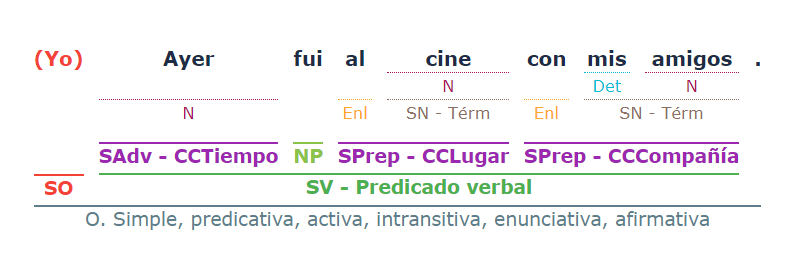
- Yesterday I went to the cinema with my friends.
- Yesterday: adverb of time that indicates when the action occurred.
- fue: verb in the first person singular in the past perfect simple.
- al: contraction of "a" and "el", singular masculine definite article that accompanies the noun "cinema".
- cinema: common and singular noun that functions as a direct object of the sentence.
- with: preposition that indicates company.
- mis: possessive pronoun of the first person plural that accompanies the noun "friends."
- friends: common and plural noun that functions as an indirect object of the sentence.
Automatic online parser
Here you can practice your analyzes more, although some are paid and reduced versions.
Therefore, if you really want to prepare for the tests with confidence, ask about our courses and teachers, who will help you with everything you need to take your exams with confidence.
